Why Most AI Projects Get Stuck in Pilot Mode
AI adoption is no longer a question of awareness. Most leaders understand the opportunity. The harder question is why so many AI projects show promise in a pilot, then fail to become part of daily operations. Deloitte’s 2026 State of AI in the Enterprise report captures this shift clearly: organizations are trying to move from “ambition to activation,” but many remain more prepared strategically than operationally. In its global survey of 3,235 leaders, Deloitte found that 42% of companies believe their AI strategy is highly prepared, yet they feel less prepared across infrastructure, data, risk, and talent.
A successful AI pilot can create excitement. It may automate a report, summarize documents, answer internal questions, or support a customer service team. But scaling AI requires more than a working model. It requires a clear use case, trusted data, secure workflows, governance, training, and ownership. Without those pieces, the pilot becomes a demo instead of a durable operating capability.
Before a pilot moves to production, answer five questions.
Is the workflow specific enough to map end to end?
Are the information and data sources trusted and accessible?
Is there a clear workflow owner and a defined point for human review?
Are safeguards, permissions, exceptions, and escalation paths defined?
What measurable evidence would justify scaling?
If several answers remain unclear, the workflow is probably not production-ready yet. Resolve those gaps before expanding the pilot.
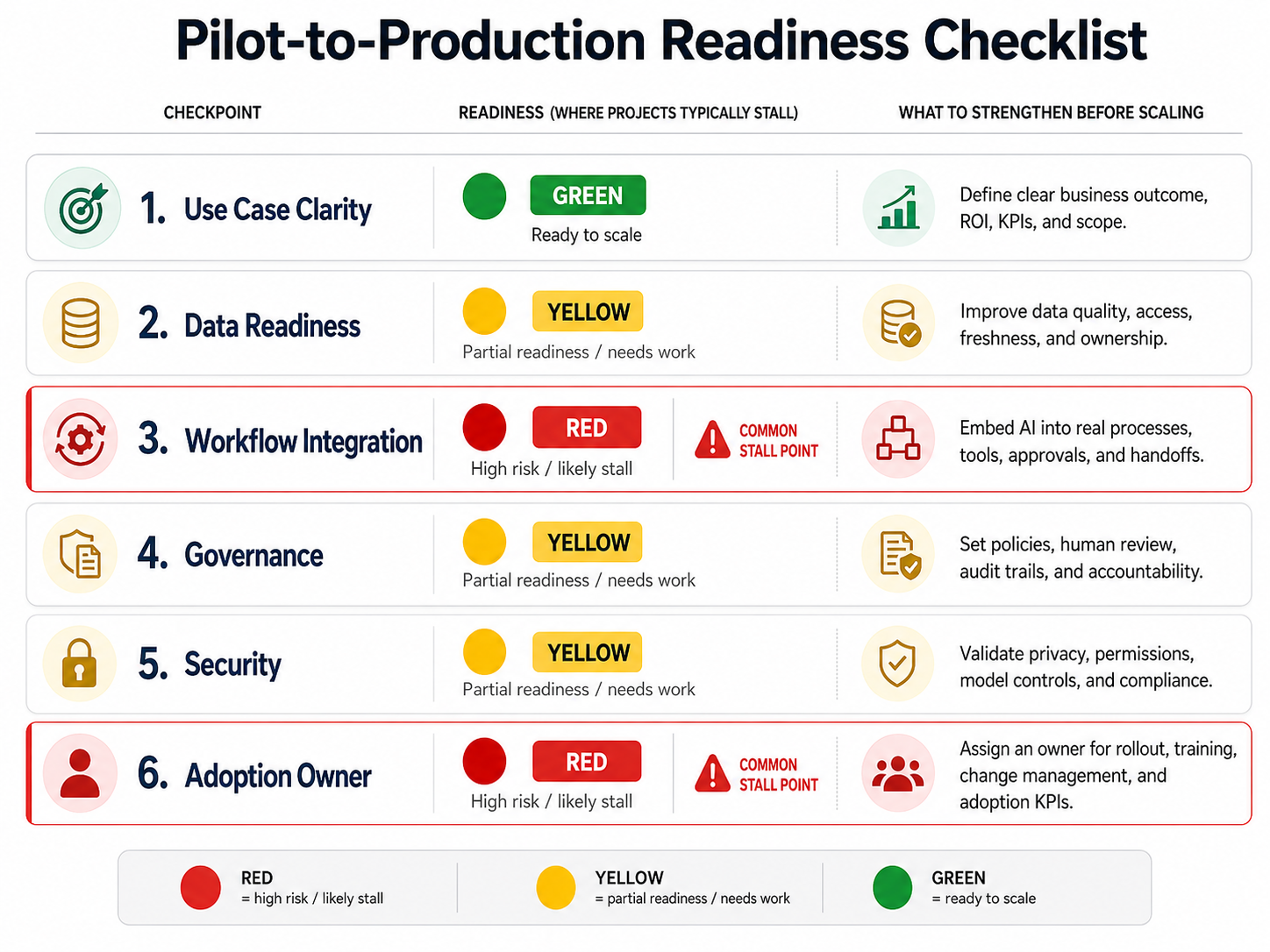
The Use Case Is Too Broad or Too Disconnected from ROI
Many AI projects start with a vague goal: “use AI to improve productivity.” That sounds reasonable, but it is difficult to scale because it does not define the workflow, the business outcome, or the success threshold.
A better starting point is a narrow, measurable use case. For example: reduce monthly reporting cycle time by 30%, decrease claims triage backlog, shorten document review time, or improve first-response quality in a support function. The use case should be tied to a real operational constraint and a KPI that leaders already care about.
This is why discovery matters. EAIS’s approach emphasizes identifying high-impact initiatives, defining success criteria with stakeholders, validating risks, and building solutions against acceptance thresholds before scaling. The goal is not to launch AI for its own sake. The goal is to put AI into a workflow where measurable value is visible early and repeatable over time.
Data and Integration Issues Surface Late
Pilots often run in controlled conditions. The data is clean, the workflow is narrow, and a small team is deeply engaged. Production is different. Real operations involve incomplete records, inconsistent naming conventions, siloed systems, exceptions, approvals, and legacy tools that were never designed for AI.
Poor data does not just reduce model performance. It undermines confidence. If employees see incorrect outputs, outdated information, or unexplained recommendations, adoption slows quickly. For knowledge-based workflows, retrieval from trusted company knowledge helps ground answers in sources employees can check.
The same is true for integration. If AI sits outside the systems people already use, it becomes one more tool to check. Scaling requires embedding AI into the flow of work—connecting data, systems, APIs, permissions, reporting, and human review steps. EAIS frames this as “production-ready” data and integration: connecting systems, cleaning and transforming data, and deploying pipelines that make AI reliable in day-to-day use.
Governance Is Treated as a Final Review Instead of a Design Principle
Security, compliance, and responsible AI concerns are among the most common reasons pilots stall. Leaders may like the business case, but legal, IT, risk, or compliance teams block expansion because the project lacks clear controls.
That is not resistance. It is operational reality.
Deloitte notes that as AI moves from experimentation to deployment, governance can be the difference between scaling and stalling. The report also highlights that only one in five companies has a mature governance model for autonomous AI agents, even as agentic AI usage is expected to rise sharply.
Governance needs to be built in from the start. That means defining who approves outputs, where human oversight is mandatory, how decisions are logged, what data the system can access, how personally identifiable information is protected, and how failures are escalated or rolled back. EAIS’s Keystone Operating Model emphasizes governance from day one, including controls, audit trails, role-based access, PII guardrails, rollback drills, and measurable KPI controls. Our plain-English guide to practical AI governance sets out a starting point for these controls.
The Workforce Is Given Access, but Not Enablement
AI access does not equal AI adoption. Deloitte found that worker access to AI rose by 50% in 2025, but it also identified insufficient worker skills as the biggest barrier to integrating AI into existing workflows.
Training cannot be limited to a one-time tool demo. Teams need to understand when to use AI, when not to use it, how to validate outputs, how to escalate exceptions, and how their role changes when routine work is automated. Managers also need to redesign workflows so AI supports the way work actually happens.
This is where ownership becomes critical. Every scaled AI initiative needs an adoption owner: someone accountable for usage, training, feedback loops, process changes, and KPI tracking. Without an owner, AI becomes optional. Optional tools rarely change operations.
A worked example: commercial-loan document intake
Consider an illustrative, hypothetical commercial-loan document-intake workflow. The team receives a document package, checks it against bank-approved requirements, and identifies missing or inconsistent information. Exceptions go to a human reviewer, who checks the source documents, resolves the issues, and records clearance before the workflow continues. AI can assist with completeness checks and draft flags; people retain responsibility for clearing exceptions. This is document intake, not underwriting or credit approval.
See the full commercial-loan document-intake worked example for the handoffs, controls, and readiness gaps that need to be addressed before a test.
Moving from Pilot to Production
The companies that scale AI successfully treat it as an operating model, not a technology experiment. They start with specific use cases, validate data readiness, build governance into the workflow, train users, and measure both efficiency gains and redeployment of saved capacity.
EAIS helps organizations make that transition through a practical, adoption-ready approach: quick wins to prove value, transparent co-builds, governance from day one, and enablement programs that help teams sustain AI in daily work.
AI projects get stuck in pilot mode when they are built around tools. They scale when they are built around work.
Start with an AI Workflow Readiness Audit
For leaders deciding where to start, EAIS’s AI Workflow Readiness Audit helps determine which workflow is ready to test, what is blocking production readiness, and what needs to be fixed before scaling.