In the boardroom, AI is a revolution. In the server room, it’s a technical marvel. But in the daily flow of operations, AI is often a source of frustration. Despite the billions invested globally, a persistent "Execution Gap" remains: the space between a successful pilot and a measurable impact on the bottom line.
A 2023 Deloitte survey highlighted this disconnect, finding that while 79% of executives expect AI to transform their business, only 29% have seen significant ROI. The issue isn't the technology, modern LLMs and predictive models are more capable than ever. The problem is that many organizations treat AI as a software installation rather than an operational shift.
To move from experimentation to profit, leadership must address the three structural roadblocks that cause AI to stall at the "last mile."
1. The Insight-to-Action Paradox
Many AI initiatives succeed in the "Insight Stage." They produce impressive dashboards, identify inefficiencies, or generate draft content. However, an insight that doesn't trigger an automatic or seamless action is just more "noise" for an already busy employee.
To bridge this gap, AI outputs must be embedded directly into existing workflows. For example, a predictive model that flags a potential supply chain delay is only valuable if it also triggers an automated exception-routing process or prepares a pre-populated response for a procurement officer. When AI is built as a standalone "destination" (like a separate portal or dashboard), adoption suffers. When it is built as a "pathway" within the tools teams already use, it becomes indispensable.
2. The "Black Box" and the Trust Deficit
Operational leaders often hesitate to scale AI because they cannot see the logic behind the results. This "black box" problem creates a trust deficit. If a claims adjuster or a financial analyst doesn't understand why an AI made a specific recommendation, they are likely to ignore it or spend double the time checking AI's calculations.
Bridging this gap requires Transparent Co-Building. Rather than purchasing off-the-shelf solutions that hide their logic, organizations are finding more success by building transparently within their own cloud environments. When internal teams have access to the code, the data lineage, and the "why" behind the output, the transition from human-led to AI-augmented work happens faster and with fewer errors.
3. The Governance Bottleneck
Innovation often moves at a higher velocity than compliance. Many AI projects are sidelined by legal or IT security teams because they lack built-in safeguards for data privacy (PII) or role-based access.
Successful execution requires Governance from Day One. Instead of building a tool and then asking the legal team to approve it, leaders should incorporate a Controls Cookbook, a repeatable set of policies and audit trails, into the development phase. This ensures that every automated action is traceable and compliant, preventing the "start-stop" cycle that kills project momentum.
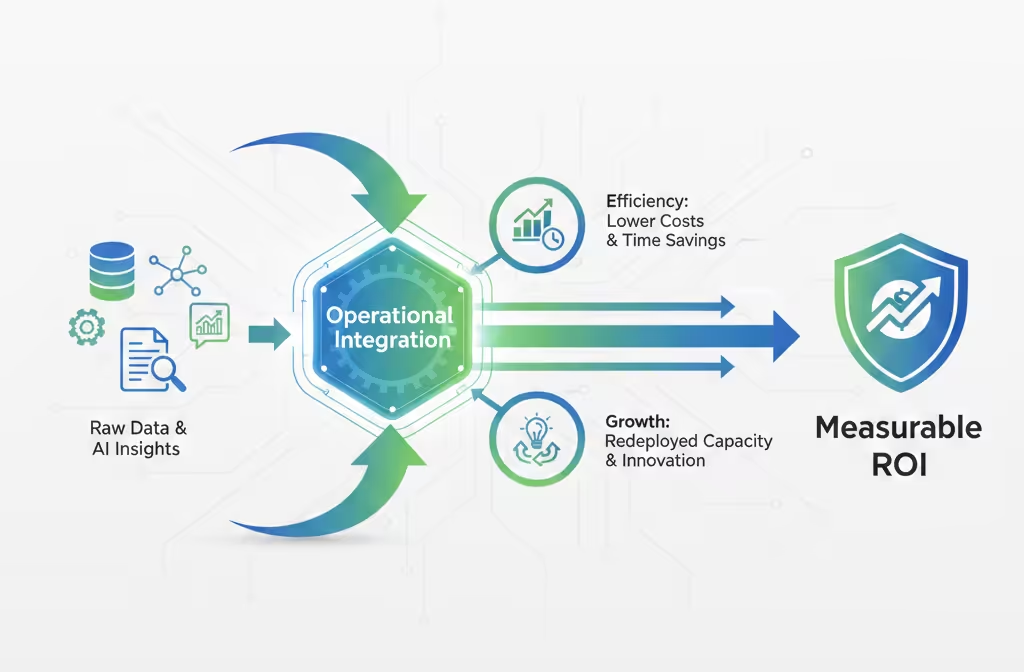
True AI ROI is dual-natured: it is measured by the hours saved (efficiency) and the value of where those hours are redeployed (growth).
Beyond Efficiency: The Redeployment Strategy
The ultimate goal of closing the execution gap is not just to save time. If a department saves 500 hours a month through AI but doesn't have a plan for those hours, that capacity often simply evaporates into lower-value tasks.
Forward-thinking organizations use a Redeployment Plan. This is a formal strategy to shift saved human capacity toward high-margin activities that AI cannot do: complex problem solving, strategic relationship building, and creative innovation. This shift from busywork to high-value work is where the most significant ROI is found.
How EAIS Can Help
At Emergent AI Solutions (EAIS), we specialize in bridging this last-mile gap. Through our Keystone Operating Model™, we help organizations move beyond the pilot phase by focusing on adoption-ready AI. We don’t just deliver technology; we provide the frameworks, like our Operator Academy and AI Audit Kits, that empower your team to operate and scale AI independently.
By prioritizing transparency, governance, and measurable KPIs, we ensure that AI isn't just a technical success, but a business one.
Conclusion The organizations that will lead the next decade aren't necessarily those with the most advanced algorithms, but those with the best operational discipline. By focusing on the last mile and integrating insights into actions, building trust through transparency, and planning for human redeployment, leaders can finally turn the promise of AI into a predictable driver of growth.
Learn more about how EAIS can support your operational goals and help you bridge the execution gap.