Most business leaders have now experimented with generative AI. They have asked a chatbot to draft an email, summarize a document, or brainstorm ideas. That is useful, but it is only the beginning. The next wave is AI agents: systems that can plan, use tools, and complete multi-step work with less hand-holding.
Google Cloud defines AI agents as software systems that use AI to pursue goals and complete tasks on behalf of users, often using reasoning, planning, memory, and a level of autonomy. IBM similarly describes agents as systems that can design workflows, call tools, and perform actions across external environments.
For businesses, this shift matters because agents move AI from “answering questions” to “getting work done.” But the opportunity comes with an important reality check: agents are not magic employees. They still need structure, controls, and human oversight to produce reliable business outcomes.
What Makes an AI Agent Different from a Chatbot?
A chatbot responds to a prompt. An AI agent works toward a goal.
For example, a chatbot can help draft a meeting agenda. An AI agent could review calendars, identify available time slots, draft the agenda, send the invite, attach relevant documents, and remind attendees of open action items. The difference is not just language generation. It is planning, tool use, and execution.
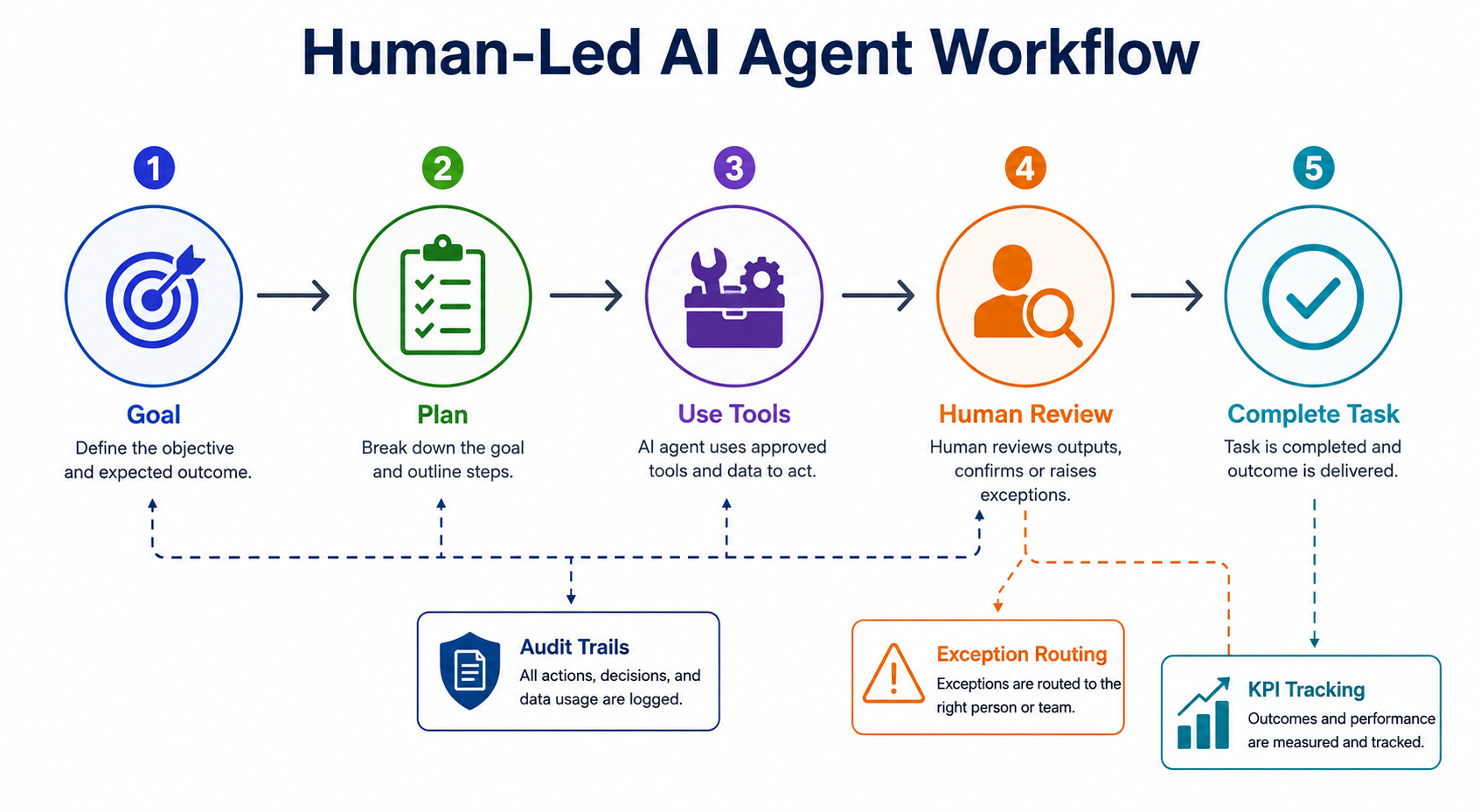
In a business setting, agents can connect to systems such as email, CRM platforms, ticketing tools, spreadsheets, knowledge bases, and reporting dashboards. They can break a larger request into smaller steps, decide which tool to use, retrieve information, take an action, and then check whether the task is complete.
That makes AI agents especially relevant for work that is repetitive, information-heavy, and spread across multiple systems. Scheduling is one simple example. Research is another. Instead of asking an employee to gather background information from five sources, an agent can collect, summarize, compare, and package the findings for review.
Where AI Agents Can Create Business Value
The clearest early opportunities are not usually the most futuristic. They are the workflows that already drain time from capable teams.
In report generation, an AI agent could pull data from multiple systems, identify missing inputs, draft a management summary, and route exceptions to the right analyst. In customer support, an agent could classify a ticket, search approved knowledge sources, draft a response, and escalate complex cases to a human. In internal operations, agents could help with onboarding checklists, policy lookups, invoice triage, vendor research, or compliance documentation.
These use cases are powerful because they reduce busywork without removing human judgment. Employees still make decisions, handle exceptions, and approve sensitive outputs. The agent handles the repetitive steps around the work.
This aligns closely with how EAIS approaches adoption-ready AI: focusing on measurable outcomes, reducing busywork, and using governance from day one to mitigate risk. EAIS’s Keystone Operating Model emphasizes agentic automation, transparent co-build, KPI-based controls, data protection, and human oversight as core parts of implementation.
The business case is not simply “do more with fewer people.” It is “free people to do higher-value work.” That might mean giving analysts more time for interpretation, enabling customer support teams to focus on complex issues, or helping operations leaders improve cycle times without adding manual burden.
Why Oversight Still Matter
AI agents can be impressive in demos, but production environments are more demanding. Real workflows include messy data, inconsistent processes, unclear ownership, exceptions, compliance requirements, and systems that do not always behave as expected.
Recent research on enterprise agentic AI systems highlights a key issue: evaluating agents only on task completion is not enough. Reliability, cost, latency, security, and policy compliance also matter. One study found that agent performance can drop significantly when consistency across repeated runs is measured, underscoring the need for broader evaluation before deployment.
Another 2026 study on agent failures found that failures can be difficult to diagnose because agent workflows are probabilistic, multi-step, and affected by tool outputs. In other words, an agent may fail not because the final answer looks obviously wrong, but because something went off track in the middle of the process.
That is why businesses need a human-led AI loop: decide, automate, review, and improve. Agents should have clear goals, approved tools, defined permissions, audit trails, exception routing, and acceptance thresholds. For high-risk actions, such as sending customer communications, changing records, approving payments, or making compliance-sensitive recommendations, human review should remain mandatory.
How Businesses Should Prepare
The best place to start is not with a platform decision. It is with a workflow decision.
Identify a process that is frequent, measurable, and painful. Define what success would look like: faster turnaround, fewer errors, lower rework, better first-response time, or more complete reporting. Then map the workflow step by step. Which tasks can an agent safely handle? Which require human approval? Which systems need to connect? What data should the agent never access?
EAIS helps organizations approach this through practical discovery, transparent co-building, and governed implementation. Its delivery model emphasizes selecting high-impact use cases, defining success criteria, validating data and risks, operating in shadow mode until acceptance thresholds pass, and monitoring performance after launch.
AI agents are coming because they solve a real business problem: too much valuable human time is trapped in repetitive, multi-step digital work. Used well, agents can support scheduling, research, reporting, customer support, and internal operations while helping teams move faster and focus on higher-value decisions.
The companies that benefit most will not be the ones that chase autonomy for its own sake. They will be the ones that combine automation with oversight, governance, and measurable outcomes.
Learn more about how EAIS can support your goals with governed, adoption-ready AI agents that your team will actually use.